
Marshall County Arrest Records Path
After a Marshall County arrest, the first public record may be the jail booking profile. The sheriff roster can show a name, booking number, booking date, arresting agency, charge text, and a booking photo when available. That record is useful for custody, but the sheriff warns that charges and bail amounts may change after court appearances and may not be current. Formal court charges are tracked through the Alabama trial-court system, the Circuit Clerk, and, for some city matters, a municipal court.
The court path depends on the offense. District Criminal handles misdemeanor cases outside city limits, worthless checks, conservation tickets, revenue commission tickets, and ABC violations. Felony cases begin in District Court and remain there until grand-jury action. Municipal misdemeanors, traffic cases, ordinance violations, and city warrants may sit with Albertville, Arab, Boaz, or Guntersville municipal court. The jail roster side is covered in Marshall County jail inmate records, while booking photos are covered through Marshall County jail mugshots.
Find Marshall County Court Records After Arrest
The official paid online portal is Alacourt Access. It offers Alabama trial-court record access by name or case number and can return basic case information, court actions, case status, setting dates, party information, financial history, case action summaries, and document images when available. Because a no-match name search still counts as a paid search, gather the spelling, booking date, arresting agency, and any case number before searching.
- Use the sheriff roster first to confirm the booking date, arresting agency, and booking-charge text.
- Search Alacourt by case number if available, or by name if no case number is known.
- Open the case detail and compare each filed charge to the jail booking charge.
- Review the case status, setting dates, court actions, financial history, and document image options.
- If online access is not enough, use the public-access computer at the Guntersville Circuit Clerk's Office or contact the correct clerk division.
The Marshall County Circuit Clerk site lists Angie Johnson as clerk and gives courthouse locations in Guntersville and Albertville. The Guntersville office is listed at 424 Blount Avenue, Suite 201, with phone 256-571-7785, and the Albertville location is at 133 South Emmett Street, with phone 256-878-4521. Both are published with Monday through Friday, 8:00 a.m. to 4:30 p.m. hours.
The manifest screenshot for Alacourt shows the paid access path used for official trial-court searches. Source: Alacourt Access.
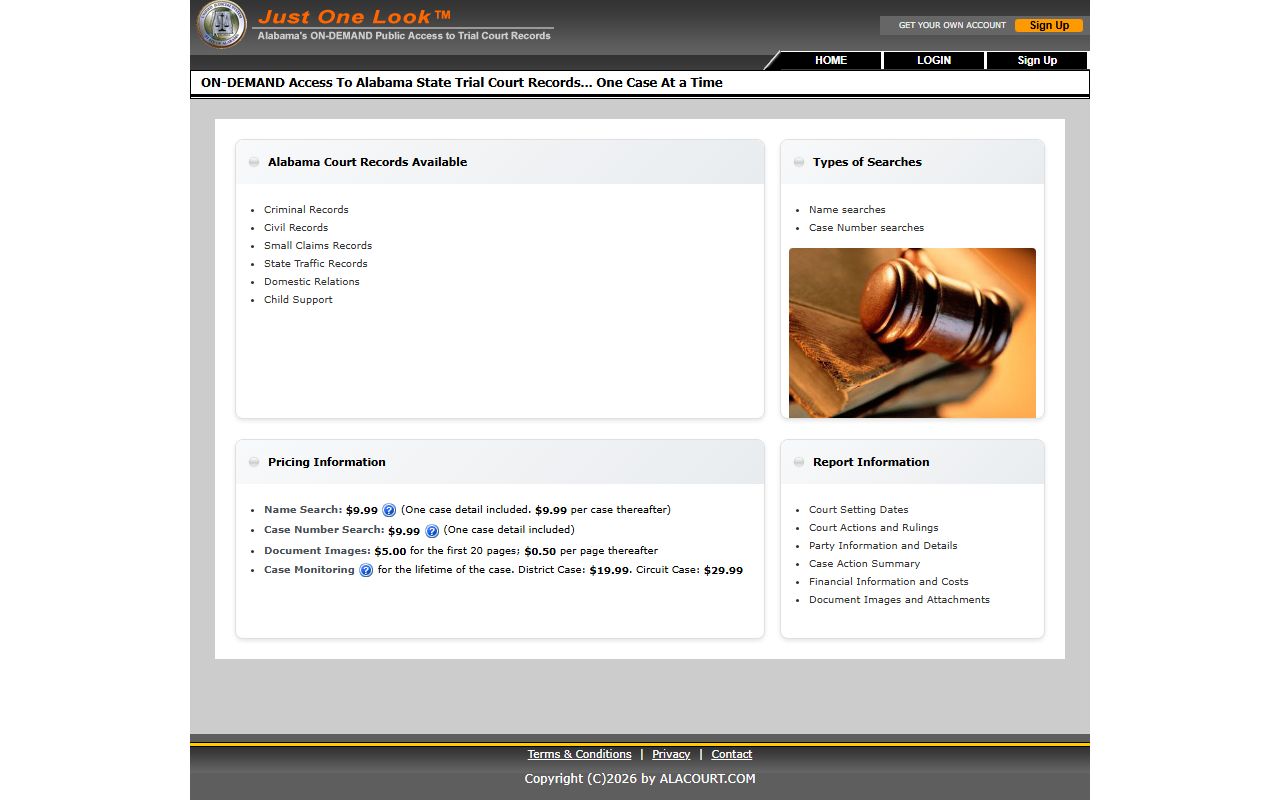
Alacourt is the statewide case-search channel, while the Circuit Clerk remains the local access point for in-person public computer searches and clerk-division routing.
Marshall County Court Records Fields
The court-search system is different from the free jail roster. It is paid, account-based for full searches, and organized around case detail rather than custody status. Use it when the question is what the prosecutor filed, whether a charge is still pending, when the next setting occurs, or how the case ended.
| Field or Item | Type | Cost or Limit | Notes |
|---|---|---|---|
| Name Search | Paid search | $9.99 | One case detail included; a no-match result counts as a search. |
| Case Number Search | Paid search | $9.99 | One case detail included. |
| Document Images | Paid document access | $5.00 first 20 pages, then $0.50 per page | Available where document images exist. |
| Case Monitoring | Paid monitoring | $19.99 district, $29.99 circuit | Lifetime case monitoring as listed by the portal. |
| Report Contents | Case detail | Varies by search | Case status, setting dates, parties, actions, financial history, and documents. |
Marshall County Charging Documents
Alabama criminal cases use specific documents to turn arrest allegations into formal charges. Rule 2.1 says criminal proceedings begin by complaint or indictment. Rule 2.3 defines a complaint as a sworn statement before an authorized official. Rule 13.1 defines indictment, information, and complaint. For a Marshall County arrest, this matters because the jail roster may show the arresting agency's initial charge, while the court file shows the document that starts or continues the criminal case.
| Document | Who Uses It | Plain Meaning | Common Local Path |
|---|---|---|---|
| Complaint | Officer, complainant, magistrate, or prosecutor process | Sworn facts alleging an offense. | Common at the start of district or municipal criminal matters. |
| Information | District attorney | DA-signed written charge used in limited circumstances. | Less common than complaint or indictment, but defined by Alabama rule. |
| Indictment | Grand jury | Written charge endorsed as a true bill. | Important for felony cases moving from District Court toward Circuit Court. |
Marshall County Charge Status
Charge status can change as a case moves from arrest to first appearance, preliminary hearing, grand jury, plea, trial, dismissal, or sentencing. A charge listed on a booking profile is an arrest or jail entry. A charge listed in Alacourt or a clerk record is the court case item. The two may differ because prosecutors can amend, add, reduce, dismiss, or decline charges.
| Status | What It Means | Why It Matters |
|---|---|---|
| Pending | The charge is open and has not reached final disposition. | Settings, bond terms, and court actions may still change. |
| Amended or reduced | The filed charge was changed by prosecutor or court action. | The current court charge may not match the jail booking charge. |
| Dismissed | The court no longer proceeds on that charge. | Dismissal is not the same as expungement. |
| Nolle prosequi | The prosecution declines to continue that charge. | It may affect expungement eligibility, but the record does not vanish automatically. |
| Convicted | A plea or verdict produced a finding of guilt. | Sentencing may move the person to ADOC if state prison is ordered. |
Note: A booking charge is an accusation at jail intake, not proof that a person was convicted.
Marshall County Bond After Arrest
Bond information crosses the jail and court systems. The sheriff corrections page says cash bonds can be posted for the full amount at the Circuit Clerk's office Monday through Friday, 8:00 a.m. to 4:30 p.m., excluding holidays and weekends. The receipt must then be produced at the sheriff's department. The local bond transmittal fee is $35 in exact cash to the Marshall County Sheriff's Department, with no checks, under Act 2012-535. Property bonds require sheriff approval and usually two property owners for felony cases unless the sheriff approves otherwise.
| Bond Type | How It Works Locally |
|---|---|
| Cash bond | Full cash amount posted at the Circuit Clerk during clerk hours, then receipt brought to the sheriff. |
| Property bond | Sheriff-approved property surety; equity counts and all owners/signers must be present with ID. |
| Surety bond | Bond company path is not detailed on the sheriff page, but bond companies are told to call jail staff to verify bail, charges, and case numbers. |
| PR bond | Personal recognizance release is a court release decision, not a published sheriff website process. |
| No-bond hold | May reflect a court order, detainer, probation issue, sanction, or other hold and must be verified. |
Marshall County Warrants and Arrest Records
The Circuit Clerk's magistrates and warrants materials say magistrates must exercise independent judgment before issuing warrants. County warrant jurisdiction includes misdemeanors outside city limits, felonies in Marshall County, county traffic offenses, and worthless checks received in the county. A person seeking a warrant starts by filing an incident or offense report with the sheriff or the city police department with jurisdiction. For felony matters, an officer or investigator obtains the warrant.
The warrant page includes an important public-record caveat: an arrest warrant is not a matter of public record until it is served. It also says a person who suspects a warrant has been issued must appear in person at the Marshall County Sheriff's Department. Misdemeanor warrant issuance is available to the public on Tuesdays from 8:00 a.m. until 3:00 p.m. Municipal warrant channels differ. Albertville, Arab, Boaz, and Guntersville publish separate municipal court or warrant instructions for city matters.
Marshall County Charges vs Convictions
Arrest records and court records can list accusations long before a final outcome. That distinction is central to reading Marshall County court records after an arrest. A charge is the claim being prosecuted. A conviction is the result after a guilty plea, guilty verdict, or other final finding of guilt. A dismissed, amended, or nolle prossed charge should not be described as a conviction.
| Item | Charge | Conviction |
|---|---|---|
| Stage | Accusation after arrest, complaint, information, or indictment. | Final result after plea or verdict. |
| Proof level | Probable cause or formal accusation. | Proof beyond a reasonable doubt or admitted guilt. |
| Where found | Jail roster, complaint, indictment, or Alacourt case detail. | Disposition, sentencing order, or criminal-history record. |
| Practical effect | May affect bond, hearings, and case settings. | May lead to sentence, probation, fines, or ADOC custody. |
Sealed and Expunged Arrest Records
Alabama law allows eligible criminal charges to be expunged under Title 15, Chapter 27, but the court grants expungement. ALEA explains that a petitioner must obtain a certified Alabama criminal-history record before filing. Expungement paperwork may need to identify the arresting agency and each agency where the person was booked, incarcerated, or detained. For a Marshall County arrest, that can mean the sheriff, a city police agency, the jail, and the court involved.
| Item | Sealed | Expunged |
|---|---|---|
| Visibility | Hidden or limited from routine public access. | Removed from public access under a court expungement order. |
| Effect | Record may still exist for authorized uses. | Eligible records are treated under the expungement statute and order. |
| Who grants it | Court or statute-based restriction. | Court after a proper petition and required records. |
| Limits | Not every arrest or charge qualifies. | Dismissal alone does not automatically erase all public records. |
Important: Juvenile records are confidential under Alabama Code Section 12-15-133, and adult expungement requires the proper court process.
ALEA and Background Records
ALEA's criminal-history process is different from both the jail roster and Alacourt. ALEA handles official Alabama criminal-history/background information through its Criminal Records Identification Unit. The research found that ALEA requires fingerprinting, a current photo ID copy, an application, and a $25 cashier's check or money order, with extra copies listed at $5. That process is often relevant for expungement or formal background purposes, but it is not a live custody lookup and it does not show the minute-by-minute status of a pending court case.
Records access also has limits. Alabama public-records law supports inspection and copying of public writings unless an exception applies, and Alabama Code Section 36-22-8 supports inspection of the sheriff's jail/prisoner book during office hours. Still, records can be limited by juvenile confidentiality, expungement orders, active investigations, law-enforcement exemptions, security concerns, and the fact that some city records have local request rules.